
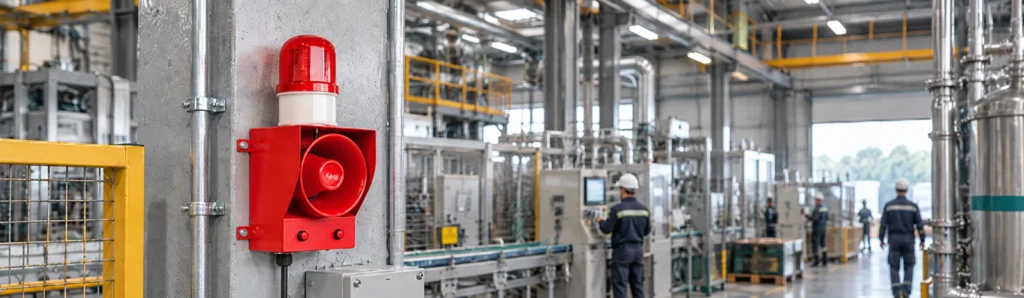
Industrial alarm siren selection depends mainly on site conditions:
- where people need to receive the warning;
- the ambient noise level;
- the power available at the site;
- the signal that will trigger the alarm;
- the installation environment.
These conditions usually narrow the product range before model-level specifications come into play. When selecting industrial alarm sirens, define the application conditions and use them to compare sound pressure level, voltage, control method, and environmental specifications.
1. Define the Warning Task and Listening Position
Start with the people who need to receive the warning and where they will normally be.
An operator beside a machine and a worker at the other end of a workshop do not have the same audible warning requirement. Personnel movement, listening distance, machinery, walls, and other obstructions can all affect the selection.
The warning also needs a defined purpose, such as:
- equipment fault;
- machine start-up;
- process abnormality;
- a condition that requires inspection or response.
For machinery and equipment warning applications, a useful description can be simple:
When a fault occurs on the packaging line, the alarm needs to alert operators working approximately 5–20 m from the equipment.
For employee alarm systems covered by OSHA 29 CFR 1910.165, alarm signals must be perceptible under the relevant workplace conditions and recognizable as a signal for the required action. The regulation has a defined scope and should not be treated as a universal requirement for every industrial alarm application.[1]
When Is a Visual Signal Also Needed?
High-noise areas, hearing protection, or applications that require a persistent status indication may also need warning lights and signal towers. When audible and visual warning need to be integrated into one device, integrated beacon sirens are another option.
Audible and visual signals serve different functions. The site conditions determine whether both are needed.
2. Evaluate Sound Pressure Level Against Ambient Noise and Listening Distance
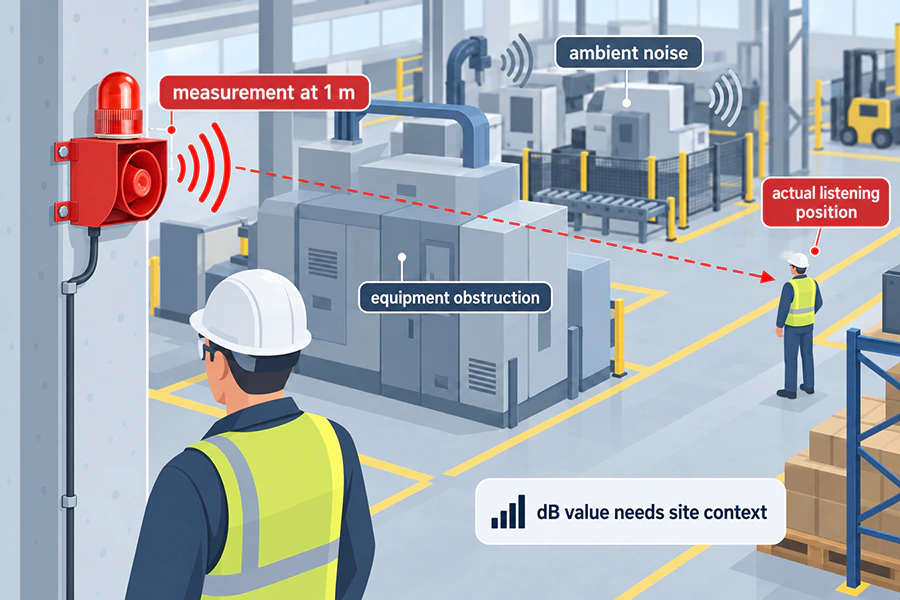
A dB value becomes useful when it is considered together with ambient noise, listening position, and the conditions under which the product was measured.
| Information | What to Confirm |
|---|---|
| Ambient noise | How noisy the site is during normal operation |
| Listening position | Where people are located and how far they are from the siren |
| Measurement conditions | The distance and conditions used for the published dB value |
NIOSH guidance on workplace noise assessment also emphasizes understanding area noise, the noise reaching workers, and the main noise sources. A sound level meter can be used to measure area noise and sound produced by specific equipment.[2]
If measured data is not available, describe the actual environment:
Enclosed production workshop with several machines operating at the same time. No site noise measurement is currently available.
Can dB Be Converted Directly into a Fixed Coverage Distance?
No. Actual audibility is affected by distance, ambient noise, machinery, walls, reflections, and mounting position.
3. Confirm Power Supply and Trigger Method Separately
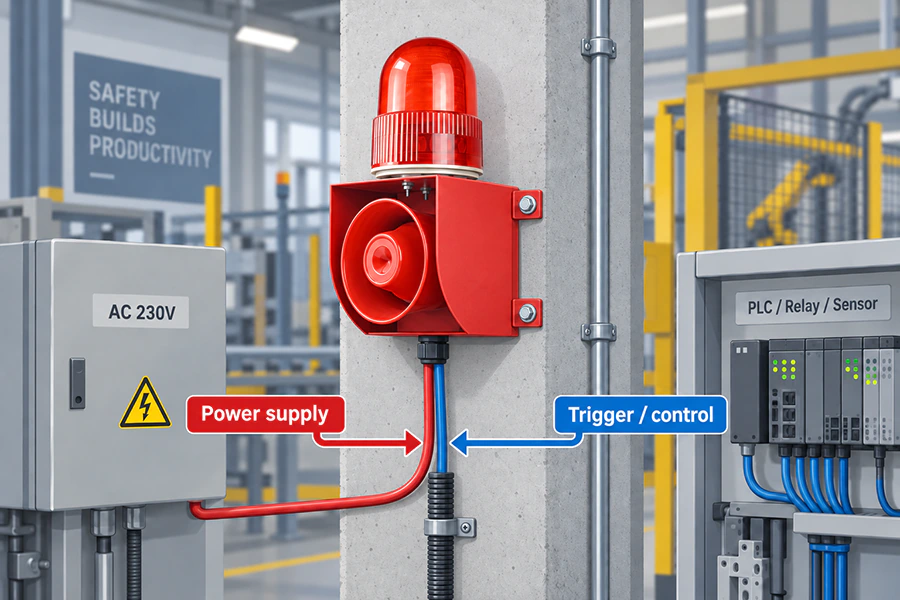
The available power supply can quickly narrow the suitable configurations.
If the equipment already provides 24V DC, check the corresponding 24V versions. If AC power is available at the installation point, confirm whether the target model has a suitable AC configuration. Supported voltages need to be verified at model level.
The trigger method answers a different question: what signal tells the siren to operate?
What Signal Will Trigger the Siren?
Common control methods may include:
- power-on;
- relay;
- dry contact;
- PLC / external signal;
- sensor;
- remote control;
- RS-485 or another communication interface.
A siren powered by 24V DC does not necessarily use a 24V control input. When the project already has a PLC, relay, or sensor, record the available output type and confirm the required interface and wiring against the selected model.
Applications where remote activation, sensor input, or automatic detection is central to the requirement can also be reviewed through the wireless and sensor alarm range.
4. Define the Installation Environment in Specific Terms
Outdoor use is not a complete product specification.
An outdoor siren may be installed under a roof or fully exposed to rain, dust, and temperature changes. For outdoor warning applications, define the conditions more precisely:
- direct rain exposure;
- dust level;
- washdown exposure;
- minimum and maximum ambient temperature;
- mounting position and method;
- cable entry;
- additional conditions such as corrosion or vibration.
For example:
Outdoor installation with no roof cover, direct rain exposure, and a minimum winter temperature of approximately -15°C.
This information can already be used to check a specific model against the site.
IEC 60529 classifies the IP Code used for electrical equipment enclosures. The current consolidated version listed by IEC is Edition 2.2, with a stability date of 2027.[3]
An IP rating mainly describes protection against solid-object and water ingress. Temperature, UV exposure, corrosion, vibration, and other environmental conditions need to be checked separately.
5. Turn the Site Conditions into a Selection Specification
The application data can be condensed into a short selection specification.
| Selection Input | Information to Record |
|---|---|
| Warning task | What condition requires an alarm and who needs to receive the signal |
| Noise & distance | Ambient noise and the main listening positions |
| Power supply | Available AC / DC power |
| Trigger / control | PLC, relay, sensor, remote, or communication |
| Environment | Water, dust, temperature, and mounting conditions |
| Project requirement | Quantity, destination market, documentation, or customization requirements |
Unknown items can simply be marked To be confirmed. Avoid filling specification gaps with estimated values.
For example:
Equipment fault alarm for a packaging production line; operators are approximately 5–20 m from the installation point; production noise is high, with no measured value currently available; 24V DC power is available; the siren will be controlled by a PLC; indoor installation with significant dust; initial quantity approximately 20 units.
This is enough information to begin comparing specific models.
Frequently Asked Questions
How Loud Should an Industrial Alarm Siren Be, and How Far Can It Be Heard?
There is no single dB value or fixed coverage distance that suits every site. Ambient noise, listening position, measurement distance, obstructions, and installation conditions all affect actual audibility.
ISO 7731 provides design principles, ergonomic requirements, and related test methods for auditory danger signals in public and work areas. ISO states that ISO 7731:2003 was reviewed and confirmed in 2022 and remains current.[4]
How Do I Choose Between 12V, 24V, 110V, and 220V?
Start with the power available at the installation point. Once the site supply is known, check whether the target model is available in the corresponding voltage version.
Can a PLC Control an Industrial Alarm Siren?
Some products can be integrated with a PLC or external control system. The actual connection depends on the PLC output type and the siren input interface. Wiring needs to be confirmed for the specific model.
Is the IP Rating Enough for an Outdoor Alarm Siren?
No. The IP Code mainly describes enclosure ingress protection. Temperature, corrosion, UV exposure, vibration, and installation conditions require separate consideration.[3]
References
- Occupational Safety and Health Administration (OSHA). 29 CFR 1910.165 — Employee Alarm Systems. Current OSHA regulation. OSHA — 29 CFR 1910.165
- National Institute for Occupational Safety and Health (NIOSH). Understand Noise Exposure. Centers for Disease Control and Prevention, updated January 31, 2024. NIOSH — Understand Noise Exposure
- International Electrotechnical Commission (IEC). IEC 60529:1989+AMD1:1999+AMD2:2013 CSV — Degrees of protection provided by enclosures (IP Code). Consolidated Edition 2.2; stability date 2027. IEC 60529 — IP Code
- International Organization for Standardization (ISO). ISO 7731:2003 — Ergonomics — Danger signals for public and work areas — Auditory danger signals. Edition 2; last reviewed and confirmed in 2022. ISO 7731:2003